Learning with AIEducation qualityResearch
AI in healthcare: from hype to professional responsibility

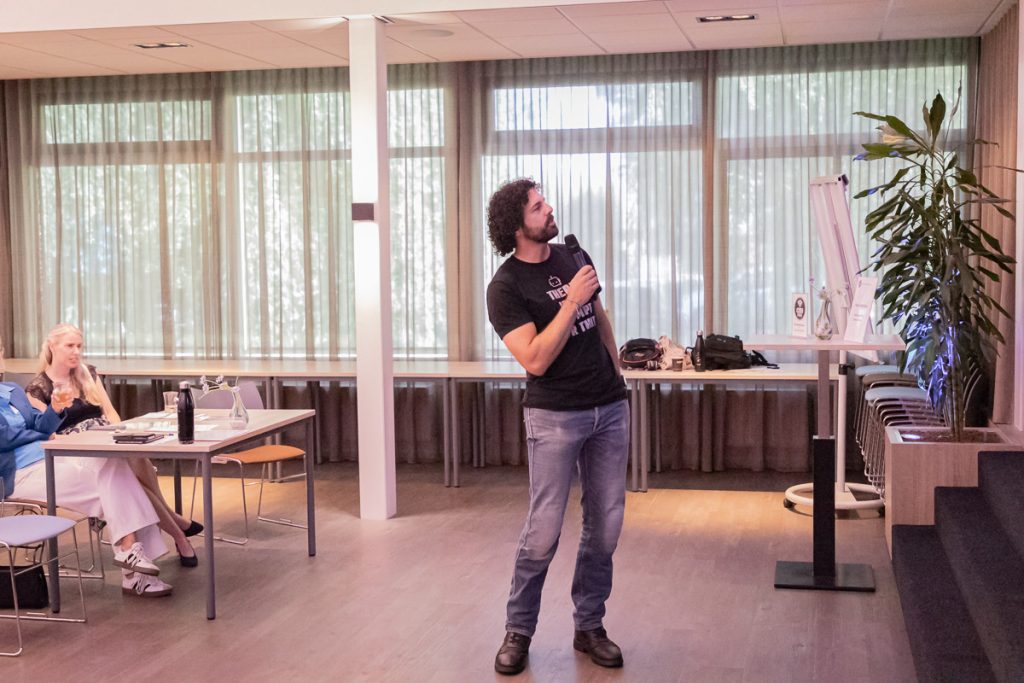
On Thursday 25 June 2026 I had the opportunity to contribute to STIP's mini-symposium AI in Healthcare – Infection Prevention at De Schakel in Nijkerk. A special afternoon, not only because of the theme, but also because two of STIP's founders were saying farewell: Carolien Oldenkamp and Pieter Sloot.
My keynote was titled: “The impact of AI on practice: from hype to reality.”
And that is exactly where the heart of the matter lies for me. AI is no longer a thing of the future. It is already here. In healthcare too. In infection prevention too. So the question is not whether AI will affect the work, but above all how we shape that influence consciously, safely and with people at the centre.
Starting not with technology, but with the future
In my talk I deliberately did not start with tools, models or technical possibilities. I started with the future of work, learning and professional practice. Because AI affects not only processes, but also choices, roles, responsibilities and trust.
In infection prevention, this is especially relevant. The work demands care, up-to-date knowledge, professional judgement and clear communication. AI can support this, for example by finding protocols faster, summarising guidelines, preparing policy or exploring scenarios. But AI must never thoughtlessly replace professional judgement.
Especially in the age of AI, the question remains important: what do we leave to technology, and what must explicitly remain human?
From 70 years of AI to today's practice
During the keynote we also took a short journey through the history of AI. Because although AI feels new to many people, the field has existed for more than 70 years. What is different now is the speed with which generative AI has become accessible to professionals in almost every sector.
That accessibility makes AI powerful, but it also calls for AI literacy. Not everyone needs to become a programmer or data scientist, but every professional does need to understand what AI can and cannot do, where the risks lie and how to keep looking critically at output.
In healthcare in particular, this is essential. AI can sound convincing and still be incomplete, incorrect or stripped of context. That is why human oversight remains indispensable.
AI as a companion, not a replacement
An important principle in my talk was this: do not see AI as a replacement for the professional, but as a companion. A good AI application helps you think, sharpens your questions, speeds up preparatory steps and supports reflection.
At CareGPT we work from that same principle. Not: “AI takes over.” But: “AI helps professionals work better, faster and more consciously, within clear frameworks for safety, privacy and responsibility.”
This means that AI applications in healthcare must fit everyday practice. They must be understandable, handle data safely, be transparent in use and support the professional rather than bypass them.
An afternoon full of recognition and conversation
What stayed with me most from the symposium was the openness in the room. There was curiosity, but also healthy caution. That very combination is valuable. AI does not call for blind enthusiasm, but nor does it call for fear or standing still.
During the interactive parts and the AI tasting session, great conversations arose about practical applications, ethical boundaries, time savings, protocols, knowledge sharing and the role of the healthcare professional. The strength lay not only in the technology, but above all in the questions that were asked.
Because in the end, responsible use of AI does not start with a tool, but with a good conversation.
Thank you to STIP
Many thanks to STIP for the invitation and the excellent organisation. It was wonderful to explore, together with professionals from infection prevention, healthcare, software and innovation, what AI can mean for practice.
My conclusion after this afternoon is clear: AI is going to change healthcare, but how it does so is still open. So let us approach that change not only technically, but above all in a human-centred, professional and careful way.
Because good AI in healthcare does not start with artificial intelligence.
It starts with real responsibility.