How-to guidesLearning with AIEducation qualityResearch
Who is really thinking here?

Who is really thinking here? I ask myself that question more and more often when I see students working with AI.
The friction is not in the technology. The friction arises when a student gets an answer before their own question has been worked out, and no longer knows whether they have been helped or overtaken.
Rules say what is allowed. Training teaches how it works. But between the two lies an area we rarely have words for. And that is exactly where learning happens.
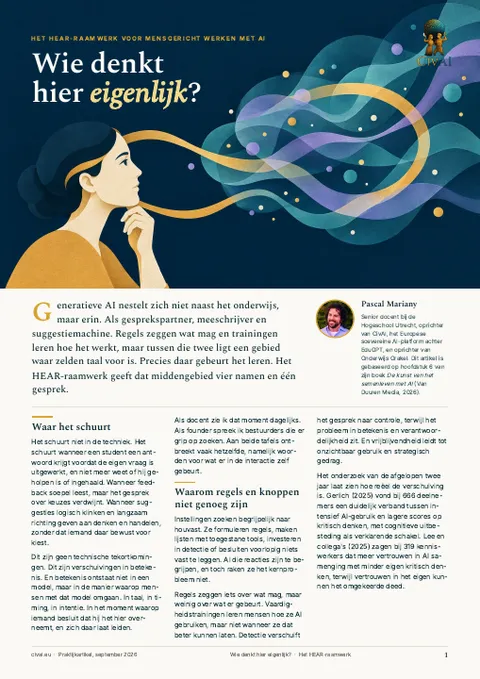
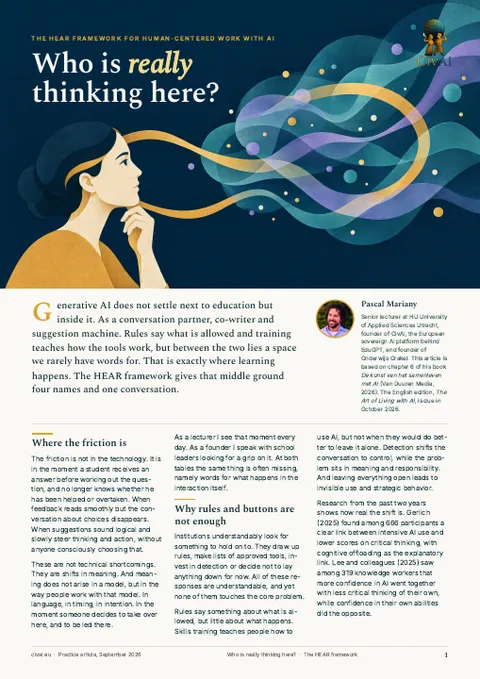
That is why I wrote a practice-based article about the HEAR framework from my book De kunst van het samenleven met AI (The Art of Living with AI). Four layers, one conversation. Human Intent, Expressive Interaction, AI Mediation and Reasoned Responsibility. Two layers lie with the human, two in the interaction with the system. The human stands at the beginning and at the end.
With two infographics, sixteen sources and six concrete starting points for teachers and teams. And a look at how we designed the AI companions in EduGPT on the basis of HEAR.
Especially in the age of AI, the question is not whether students may use AI, but what kind of thinking we want to see.
The article can be downloaded free of charge in Dutch and English:
I am curious. Where in your teaching is thinking still visible, and where has it quietly shifted to the system?